
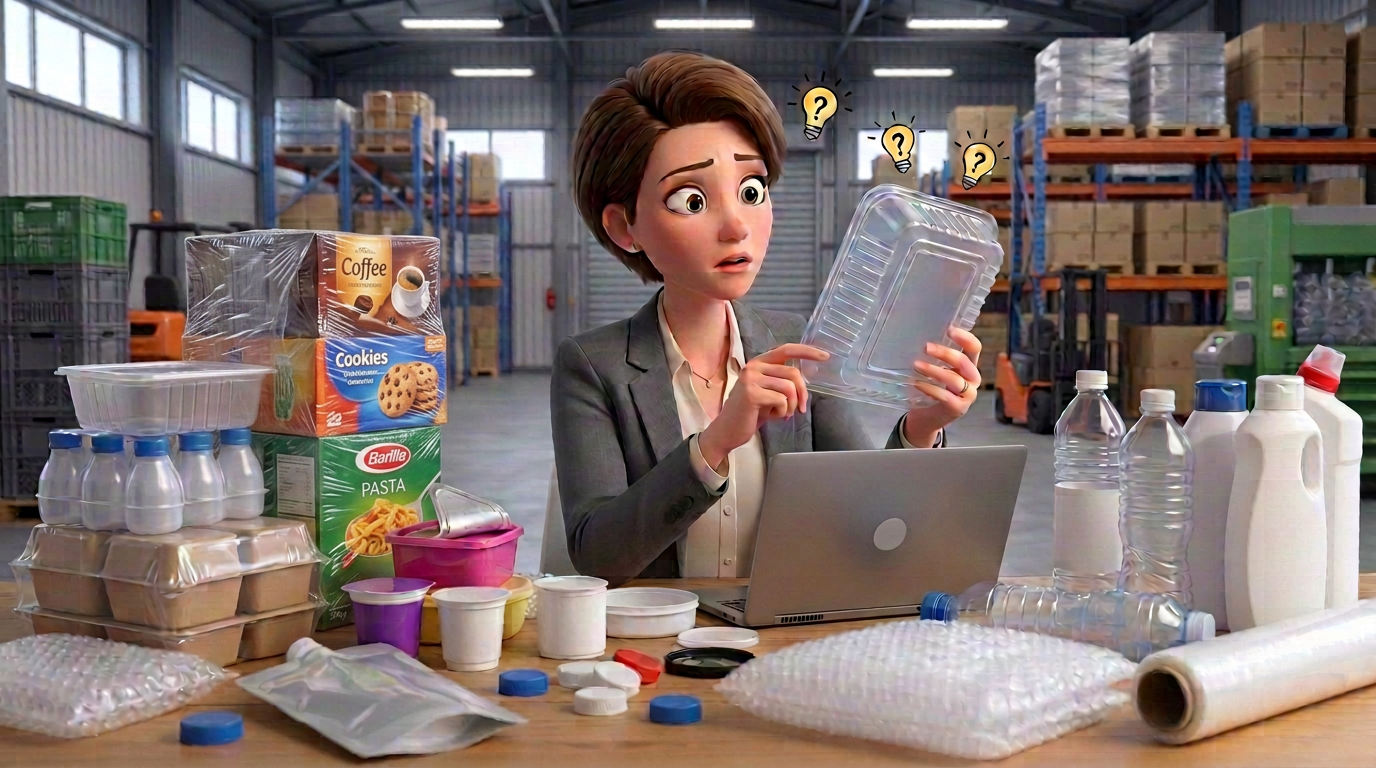
For Extended Producer Responsibility (EPR) reporting, knowing that your packaging contains plastic is not enough.
You will need to know whether it's PET, PE, PVC, PP, PS—or a multilayer combination. And you will need that information consistently across your portfolio, including secondary (group) and tertiary (transport) packaging.
If you submitted simplified EPR data to CAA this year, congratulations—you've had a small taste of what's to come.
For those reporting in Minnesota, Washington and Maryland, you might be thinking: “We have time. We'll figure out the details later.”
You do have time. But it's worth starting now.
Once you have reliable packaging data, you can start answering the questions can shape your packaging strategy:
What are our EPR fees likely to look like?
Which materials are driving those fees?
Are there materials we should consider moving away from?
Packaging changes take time. The earlier you know, the more options you have.
And there is a cost to getting the data wrong. If a material is incorrectly identified or classified, you may end up with inaccurate reporting and an unreliable picture of your EPR cost exposure.
So how do you confidently identify your plastics?
· Ask your suppliers or rely on the RIC code – expect to get inconsistent responses and RIC codes can often be absent or unreliable.
· Ask your packaging team - they know a lot. But asking them to catalogue the precise composition of thousands of packaging components isn't necessarily the best use of their time.
· Use technology - this is where near-infrared spectroscopy (NIR) comes in. This technology uses how light interacts with a material to create a unique spectral signature, which can then be used to identify the polymer.
If you've ever wondered how plastics get automatically sorted at a modern Material Recovery Facility (MRF), this is essentially the same underlying technology.
You can now have access to this technology -
Sagebrook Advisors is working with Matoha to help companies identify the plastic polymers in their packaging for EPR reporting.
It's another tool that can help you build a more accurate picture of the materials in your packaging—and ultimately better understand your EPR data and potential cost exposure.
If you're wrestling with packaging data for EPR, get in touch with Sagebrook Advisors. and if you'd like to learn more about the technology itself, take a look at Matoha.
